The F&I Manager's Complete Guide to Compliance: Protect Yourself, Your Dealership, and Your Career
Most compliance violations in F&I aren't committed by bad actors—they're caused by experienced managers who maintained clean processes 95% of the time but decided to cut corners just once. Regulatory agencies don't care about your intent or track record; they focus solely on the violation itself. Understanding this reality is the first step to building bulletproof compliance habits that protect your income, your dealership's reputation, and your long-term career in automotive finance.

Author: Adrian Anania, VP of Performance and Operations, ASURA Group
Published: March 2026
Category: F&I Career
Why Compliance Failures Happen (It's Not What You Think)
Most F&I managers who get hit with compliance issues aren't bad people. They're not crooked. They're not trying to defraud customers. They're people who ran a clean process 95% of the time — and cut a corner on the deal that came back to bite them.
That's the problem. Compliance isn't about intent. It's about documentation, consistency, and what you can prove.
The compliance violations I've seen in 16 years — across hundreds of dealerships, thousands of F&I managers — almost never happen because someone woke up thinking "I'm going to violate ECOA today." They happen in these moments:
- The customer is difficult, so you skip the survey
- The deal is almost dead, so you skip the menu and go straight to payment
- It's 7:45 PM and you want to close out, so adverse action notices go in a pile
- The lender calls with a better rate and you don't update the contract correctly
Process deviation under pressure. That's 90% of your compliance risk.
The fix isn't a compliance seminar. The fix is a process so consistent that deviation becomes the exception you catch immediately — not the norm you don't notice until a regulator points it out.
This is the principle behind the ASURA OPS framework. The F&I operator model isn't just about PRU. It's about building a process that performs AND protects — because the two are inseparable.
Here's what you need to know.
The 5 Compliance Areas Every F&I Manager Must Own
1. Red Flags Rule (Identity Theft Prevention)
What it is: The FTC's Red Flags Rule (16 CFR Part 681) requires dealers to maintain a written Identity Theft Prevention Program. As an F&I manager, you're the last line of defense before fraudulent credit applications get funded.
The process failure that creates violations:
- Skipping ID verification on deals where the customer "seems legit"
- Not documenting your identity verification steps
- Running credit without collecting required documentation
- Approving deals where the address, SSN, or other information doesn't match without escalating
What red flags actually look like:
- Address on application doesn't match credit bureau address
- SSN on application triggers a fraud alert
- Multiple recent inquiries from other dealers
- New credit file with limited history for claimed age
- Customer can't produce a clear, non-expired ID
What ASURA OPS does structurally: The client survey — completed before any credit is run — captures verified identification as a documented step. It's not a verbal check. It's a form with a signature line. When the document exists, you have proof you ran the check. When it doesn't exist, you're relying on memory in front of an investigator.
The survey isn't just a product qualification tool. It's your Red Flags compliance documentation.
2. OFAC (Office of Foreign Assets Control)
What it is: Federal law requires dealers to screen every customer against the OFAC Specially Designated Nationals (SDN) list before completing a transaction. Selling a vehicle to a sanctioned individual or entity — even unknowingly — carries severe civil and criminal penalties.
The process failure that creates violations:
- Running OFAC checks inconsistently (some deals, not others)
- Not documenting that the check was run
- Running the check but not printing or saving the result
- Using outdated screening tools or lists
The practical reality: Most dealerships use DMS or CRM integrations that pull OFAC automatically during credit app entry. But "automatic" doesn't mean "documented." You need proof the check ran and passed.
What ASURA OPS does structurally: The deal workflow is sequential and documented. OFAC check is a gated step — you don't proceed to lender submission without it. This isn't about trusting your DMS. It's about having a paper trail that shows every deal went through the same checkpoints.
3. ECOA (Equal Credit Opportunity Act)
What it is: ECOA prohibits discrimination in credit transactions based on race, color, religion, national origin, sex, marital status, age, or because the applicant receives public assistance. For F&I managers, violations typically fall into two categories: disparate treatment and adverse action notice failures.
Disparate treatment means treating customers differently based on protected characteristics — offering different products, different rates, different payment structures to different customers based on how they look or where they're from.
The process failure that creates violations:
This is where inconsistency becomes a legal liability. If you present the menu differently to some customers — skipping products, adjusting your pitch based on assumptions about what they can afford — you've created a statistical pattern that regulators can identify.
They don't need proof you discriminated intentionally. They need your deal data showing that customers in protected classes received systematically different presentations than similarly-situated customers outside those classes.
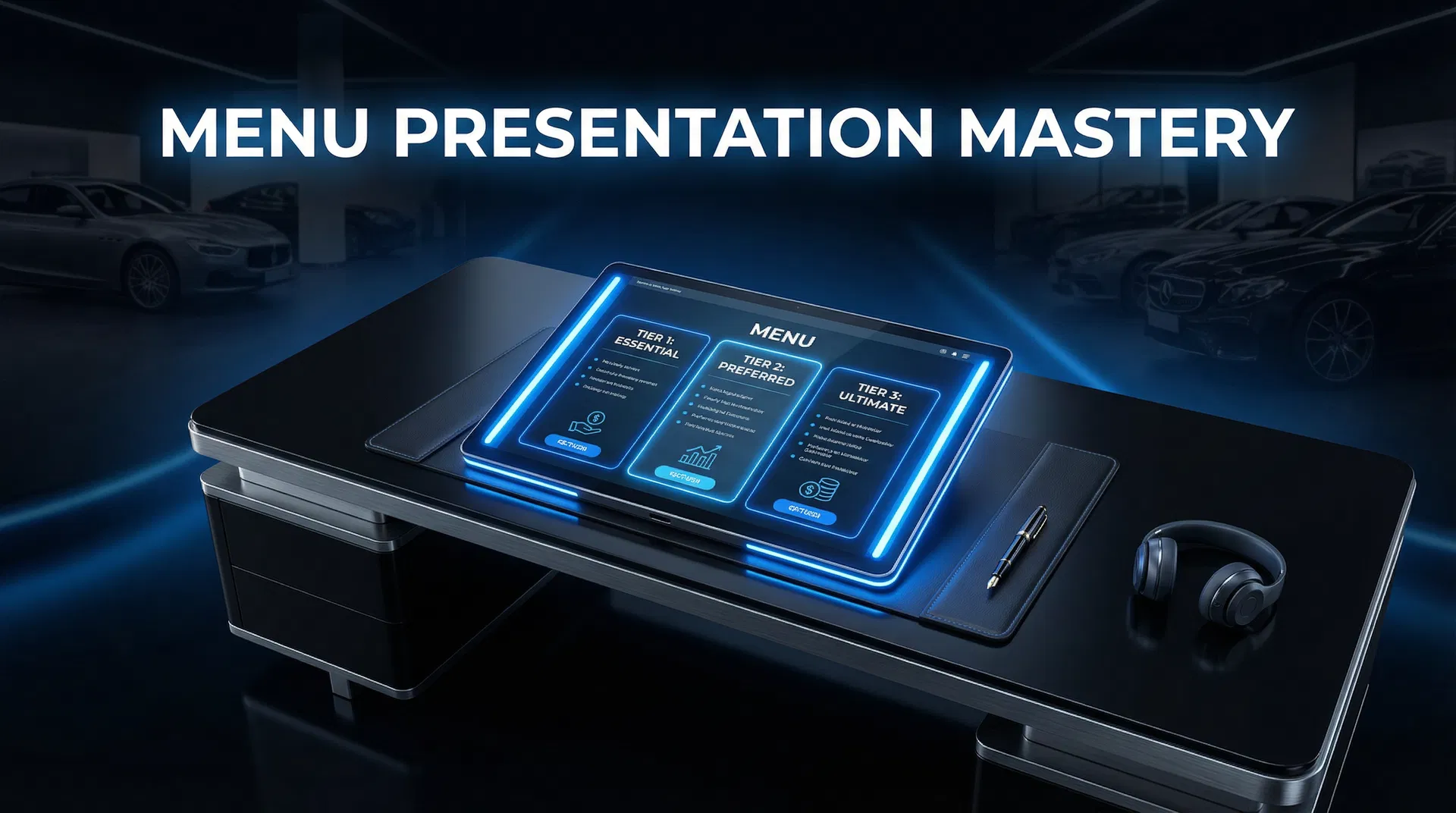
What ASURA OPS does structurally: The Menu Order System presents products in the same sequence, to every customer, every time. No judgment calls. No "this customer won't want GAP." The menu is the same. What changes is the customer's response — which you document and respect.
This isn't just good process. It's your ECOA defense.
Adverse action notices: If a customer is denied credit or receives less favorable terms, ECOA requires written adverse action notices within 30 days. Most violations aren't intentional — they're administrative failures. Deals fall through the cracks. Lenders counter without anyone tracking the 30-day clock.
ASURA OPS fix: The coaching cadence includes administrative checkpoints that catch adverse action requirements before the deadline. It's on the weekly ops review. It doesn't fall through the cracks because it's not managed by memory.
4. Menu Documentation Requirements
What it is: While there's no single federal "F&I menu law," multiple federal and state regulatory frameworks — including FTC regulations, state insurance commissioner rules, and lender agreements — create disclosure requirements that the menu satisfies when used correctly.
More importantly: your menu is your primary defense document if a customer later claims they didn't know about a product, didn't understand what they were buying, or claims a product was added without their knowledge.
The process failure that creates violations:
- Presenting the menu verbally without getting a written acknowledgment
- Letting the customer sign a blank or pre-filled menu
- Not having the customer initial next to each declined product
- Using a menu that doesn't clearly show the cost of each product separately
- Completing the purchase agreement before the menu is signed
The $5,000 lesson: I worked with a store where a customer filed a complaint claiming he didn't know GAP was included in his deal. The F&I manager knew he'd presented it. But the menu in the deal jacket had the customer's signature at the bottom — no initials on declines, no line-item acknowledgment of GAP. That "he said / she said" cost the store $5,000 and six weeks of investigation.
What ASURA OPS does structurally: The menu is a documented customer interaction — not a sales presentation. Every product has a price. The customer initials each column. The signed menu goes in the deal jacket. If the customer later claims they didn't know about a product, you have their signature acknowledging it was presented.
This is why the menu is Pillar 1 of ASURA OPS. It's not just about revenue. It's about documentation.
5. Product Disclosure Requirements
What it is: F&I products — service contracts, GAP, credit life, disability, and others — are regulated at the state level through insurance commissioner rules, and at the federal level through TILA and other consumer protection frameworks. The requirements vary by state but generally include: clear disclosure of what the product covers, the right to cancel, refund policies, and the requirement that the product be optional.
The process failure that creates violations:
- Not clearly stating that products are optional (or creating a structure where they don't feel optional)
- Bundling products in payment quotes without disclosing individual costs
- Failing to provide customers with their copy of the contract or policy
- Not disclosing cancellation rights or refund policies
State-specific exposure: If you're in California, New York, Texas, or any state with active insurance commissioner oversight, your product disclosure requirements go beyond federal baseline. Know your state.
What ASURA OPS does structurally: The survey creates the conversation framework before any product is presented. The menu is structured to show products individually with individual costs. Optionality is baked into the language — customers choose, they don't get enrolled. Documentation goes in the deal jacket with copies to the customer.
How ASURA OPS Is Structurally Compliant
Here's the core insight: the F&I managers who face compliance issues are improvising. The ones who don't are running a documented process.
ASURA OPS doesn't add compliance as a separate track. It's built in:
The Client Survey → Creates documented awareness of customer identity, financial situation, and product interest. Satisfies Red Flags documentation requirements. Creates the paper trail for ECOA consistency.
The Menu Order System → Presents all products to every customer in the same sequence. Eliminates disparate treatment. Creates documented product disclosure with customer acknowledgment.
The Objection Prevention Framework → Removes the pressure that causes managers to deviate. When you have a system for handling objections, you don't skip the menu because a customer pushes back. You run the process.
The Coaching Cadence → The coaching cadence reviews deal documentation regularly. Catches adverse action deadlines. Identifies when managers are deviating from process before it becomes a pattern. The data-driven F&I approach means you have numbers that tell you when something's off — before a regulator does.
The system monitors itself. That's the point.
The Compliance-Performance Connection
Here's what the compliance seminars never tell you: the process that makes you compliant is the same process that makes you money.
Consider what running a clean, documented, consistent process actually does for your PRU:
The survey qualifies customers for products before you're in the box. You know what they need, what they can afford, what they're worried about. That's not compliance overhead — that's your sales intelligence.
The menu presented consistently means you never skip a product with a customer who would have bought it if you'd offered it. I've seen managers convince themselves a customer "doesn't need" GAP on a 120% LTV deal. That's a $600 gross left on the table — and a compliance exposure if something goes wrong.
Documented declines mean you know when a customer came back to buy what they initially declined. Without documentation, that's a guess. With documentation, that's a process improvement you can replicate.
The stores with the best compliance records in my client base also have the best PRU numbers. That's not coincidence. It's what happens when a process is doing both jobs simultaneously.
Protecting Your Career Long-Term
This section is direct, because the stakes are real.
An F&I compliance investigation can end your career even if you didn't do anything intentionally wrong. State regulators can pull your insurance license. A consent order can follow you to your next job. A civil lawsuit from a customer can expose you personally, not just the dealership.
What protects you:
- Documentation in every deal jacket — signed menu, survey, OFAC confirmation, adverse action notices (where applicable)
- Process consistency — if every deal looks the same procedurally, there's no pattern for a regulator to find
- Coaching oversight — regular review of your deals by someone who's looking for deviation before it becomes a habit
- Knowing your state's specific requirements — TILA, state insurance regs, DMV rules for add-ons vary. Know yours.
What doesn't protect you:
- "I've always done it this way"
- "My manager told me to"
- "The customer said it was okay"
- "That's not how we do it here"
None of these are defenses. Documentation is a defense. Process is a defense.
The ASURA Programs exist because this isn't theoretical. I've been in the room when deals go sideways. I've helped stores recover from investigations. The common thread in every situation that could have been prevented: someone deviated from process and had nothing to show for it.
Build a process that protects you. Run it the same way every time. Document everything.
That's compliance. That's also performance. They're the same thing.
Frequently Asked Questions
What are the most important compliance laws F&I managers need to know?
The federal framework that directly affects F&I managers includes: the Red Flags Rule (identity theft prevention), ECOA (Equal Credit Opportunity Act, covering non-discrimination and adverse action), TILA (Truth in Lending Act, covering rate and payment disclosures), OFAC screening requirements, and state-level insurance regulations governing F&I product sales. Most violations F&I managers face come from inconsistent process, not intentional rule-breaking.
What is the Red Flags Rule and how does it affect F&I?
The Red Flags Rule (16 CFR Part 681) requires dealers to maintain a written Identity Theft Prevention Program. In practice, this means F&I managers must verify customer identity, recognize warning signs of fraud (discrepancies in application information, fraud alerts on credit files, mismatched addresses), and document those checks. The most common failure is running these checks inconsistently or failing to document them.
What is ECOA and why does it matter in the F&I office?
ECOA (Equal Credit Opportunity Act) prohibits discrimination in credit transactions based on protected characteristics including race, sex, age, national origin, and others. For F&I, the main risks are: (1) presenting products or rates differently to different customers based on assumptions about protected characteristics, and (2) failing to send adverse action notices within 30 days when credit is denied or terms are materially changed.
What is an adverse action notice and when is it required?
An adverse action notice is a written notification to a credit applicant when credit is denied, the requested amount is reduced, or the terms offered differ materially from what was applied for. ECOA and the Fair Credit Reporting Act both require these notices within specific timeframes (generally 30 days under ECOA). The most common F&I failure is letting these fall through administrative cracks on deals that didn't close.
Do F&I menus have to meet specific legal requirements?
There is no single federal "F&I menu law," but multiple regulatory frameworks create effective menu requirements. Menus should clearly show the cost of each product individually, be presented to every customer consistently, require customer acknowledgment (initials or signature) for each product selected or declined, and be retained in the deal jacket. State-specific insurance regulations may impose additional requirements.
What happens if an F&I manager is found non-compliant?
Consequences vary by violation type and severity. At the dealership level: FTC investigation, consent orders, fines. At the individual level: state insurance license suspension or revocation, personal civil liability in customer lawsuits, and difficulty obtaining future employment. The career risk is real. Even unintentional violations can result in license action if the pattern suggests systemic issues.
How does OFAC apply to car dealerships?
The Office of Foreign Assets Control (OFAC) requires dealers to screen customers against the Specially Designated Nationals (SDN) list before completing vehicle sales. Selling to a sanctioned individual — even unknowingly — carries severe civil and criminal penalties. Most DMS systems include OFAC screening, but the key is documentation that the check was run and passed on each deal.
Can a compliant F&I process also be a high-performing one?
Yes — and this is the core argument that changes how you think about compliance. The documentation requirements of a clean F&I process (survey, menu, signed acknowledgments, deal jacket retention) are the same steps that give you the sales intelligence, product presentation consistency, and administrative discipline to maximize PRU. The managers I've coached who have both the best compliance records and the highest PRU numbers are running the same documented process on every deal. That's not coincidence.
Adrian Anania is VP of Performance and Operations at ASURA Group. He has 16 years in retail automotive and 12 years coaching F&I managers nationally. His clients average a $895 PRU increase within 90 days of implementing the ASURA OPS system. Learn more at asuragroup.com/programs.
Key Takeaways
- The difference between average and elite F&I performance is mindset, system, and execution
- Tier-1 Operators build repeatable processes — they never rely on instinct alone
- Radical ownership of your results is the foundation of a $400K+ F&I career
- The ASURA System provides the framework to consistently produce elite PVR
- Continuous improvement and daily discipline separate the top 1% from everyone else
Ready to Become a Tier-1 Operator?
Join 500+ elite F&I professionals who are transforming their careers with ASURA's proven frameworks and community support.