A Day in the Life of a Top 1% F&I Professional
Most F&I managers treat their income like the weather—something that happens to them, influenced by forces beyond their control. Good month? Lucky. Bad month? Bad market. This is the victim mindset, and it is the reason most managers never break through to the next level.

What Separates the Top 1%? It's Process, Not Personality
Most F&I managers want to believe performance is about charisma. About reading the customer. About knowing when to push and when to back off. There's a version of that story that sounds good at the sales meeting and does nothing for your numbers.
Here's what's actually true: the top 1% of F&I professionals in retail automotive run a system. Not a loose set of habits — a repeatable, deliberate operating system that produces consistent output regardless of what walk-in comes through the door.
I've coached F&I managers nationally for 12 years. I've sat in the box with producers who were pulling $2,500+ PRU at stores where the average manager was doing $900. The difference was never personality. It was never "natural ability." It was operating precision.
The F&I operator model vs. the traditional manager model is the single most important distinction in this business right now. Managers react. Operators execute. Every day, on every deal, with every customer — regardless of mood, deal type, or how the morning went.
This post walks you through what a real top 1% day looks like. Not aspirationally. Operationally.
Morning: Pre-Deal Preparation Starts Before the Customer Arrives
Top producers don't start their day when the customer sits down. They start it before the store opens.
The jacket review is non-negotiable.
Before a customer arrives, a top 1% F&I professional has already pulled the deal jacket and done the following:
-
Verified the deal structure. What's the base payment? What's the term? What's the rate? What's the delta between their payment expectation and the actual payment? This tells you exactly how much compression room exists before the menu hits.
-
Reviewed the credit tier. A 720 customer and a 580 customer require different structuring conversations. You need to know which one you're walking in with before they sit down.
-
Identified the trade. If there's a trade involved, what's the equity position? Negative equity changes the product conversation — specifically around GAP — and you need to have that framing ready.
-
Noted the vehicle. New vs. used, mileage, age of vehicle, manufacturer coverage gaps — this sets up the VSC conversation before it starts.
-
Flagged deal-specific survey hooks. If you know from the trade that this customer drives 25,000 miles per year, that's your appearance product hook. If you know they're financing for 72 months on a used vehicle with 40K miles, your VSC conversation writes itself. The survey is more productive when you've already planted your anchors.
This prep takes 8–12 minutes per deal. Most F&I managers skip it entirely. They grab the jacket when the customer walks in, flip through it while the customer is sitting across from them, and wonder why they feel reactive. They feel reactive because they are reactive.
Top producers don't feel reactive because they aren't. They've already made the key decisions before the conversation starts.
The morning rhythm also includes:
-
Reviewing yesterday's numbers. PRU, penetration by product, which deals lost and where. This is a 5-minute discipline. Not a report — a diagnostic. (More on the specific metrics in Post C: The Data-Driven F&I Manager.)
-
Confirming the day's deal count and expected timing. If you know you have four deals coming in between 11AM and 3PM, you can sequence your energy and prep accordingly.
-
Mental rehearsal of the opening sequence. This sounds soft. It isn't. Athletes warm up before performance. F&I professionals who treat the box like a stage warm up before the curtain goes up. The opening sequence is the most important 90 seconds of the deal — it deserves intentional preparation.
The daily habits that separate high performers from average ones are anchored in the morning. Not the close. The morning.
The Box: Opening Sequence, Survey, and Menu
This is where the operating system lives. Everything before this was setup. This is the performance.
The Opening Sequence
The first words out of your mouth in that box set the tone for everything that follows. Top 1% producers run the same opening, word for word, every deal.
The ASURA opening:
"Complete state and federal documents, review your warranty, and get you out as quickly as possible — which is why we developed this quick client survey to speed everything up."
Then: title, address/PO Box, base payment as a statement.
Every word in that opening is deliberate.
- "State and federal documents" — not "paperwork." Paperwork sounds tedious. State and federal documents sound official and important.
- "Review your warranty" — not "show you some products." Products sounds like selling. Warranty review sounds like service.
- "Get you out as quickly as possible" — this neutralizes the #1 objection before it surfaces. The customer who's dreading being stuck in the F&I office for two hours hears this and relaxes. You've acknowledged their concern and aligned with them.
- "Quick client survey" — this is the bridge to your fact-finding. Not an interrogation. Not a presentation. A survey. Surveys are fast and feel collaborative.
Then you confirm title, address/PO Box, and state the base payment — not ask about it, state it. This is the anchor. The payment is a fact, not a negotiation point.
This opening is not a suggestion. It's not a template you customize. It runs exactly the same on every deal. The consistency is the point.
The Survey
After the opening, you run the survey. The survey is not small talk. It's structured fact-finding that does two jobs simultaneously: it builds the customer relationship and it loads your product conversations with specific, relevant hooks.
The survey has specific questions designed to surface:
- Mileage patterns (VSC and appearance product hooks)
- Parking/storage situation (appearance product hook)
- Drive time and commute (VSC hook — what happens when this car breaks down?)
- Family situation (GAP hook — who else depends on this vehicle?)
- Financing history and payment comfort (upgrade architecture foundation)
A top 1% producer listens to survey answers like a clinician. Every answer is data. When a customer says they drive 20 minutes each way on the highway, they've just given you a mileage and reliability conversation. When they mention they park outside, you have your appearance product hook. When they mention they have two kids they're dropping at school, you have your GAP conversation framed around family protection, not insurance product.
The survey is not optional. It runs on every deal. Cash deals, clean credit, repeat customers — every deal. The producer who skips the survey because "this customer doesn't need products" has already decided the outcome before the conversation started. That's not F&I. That's order-taking.
The Menu Presentation
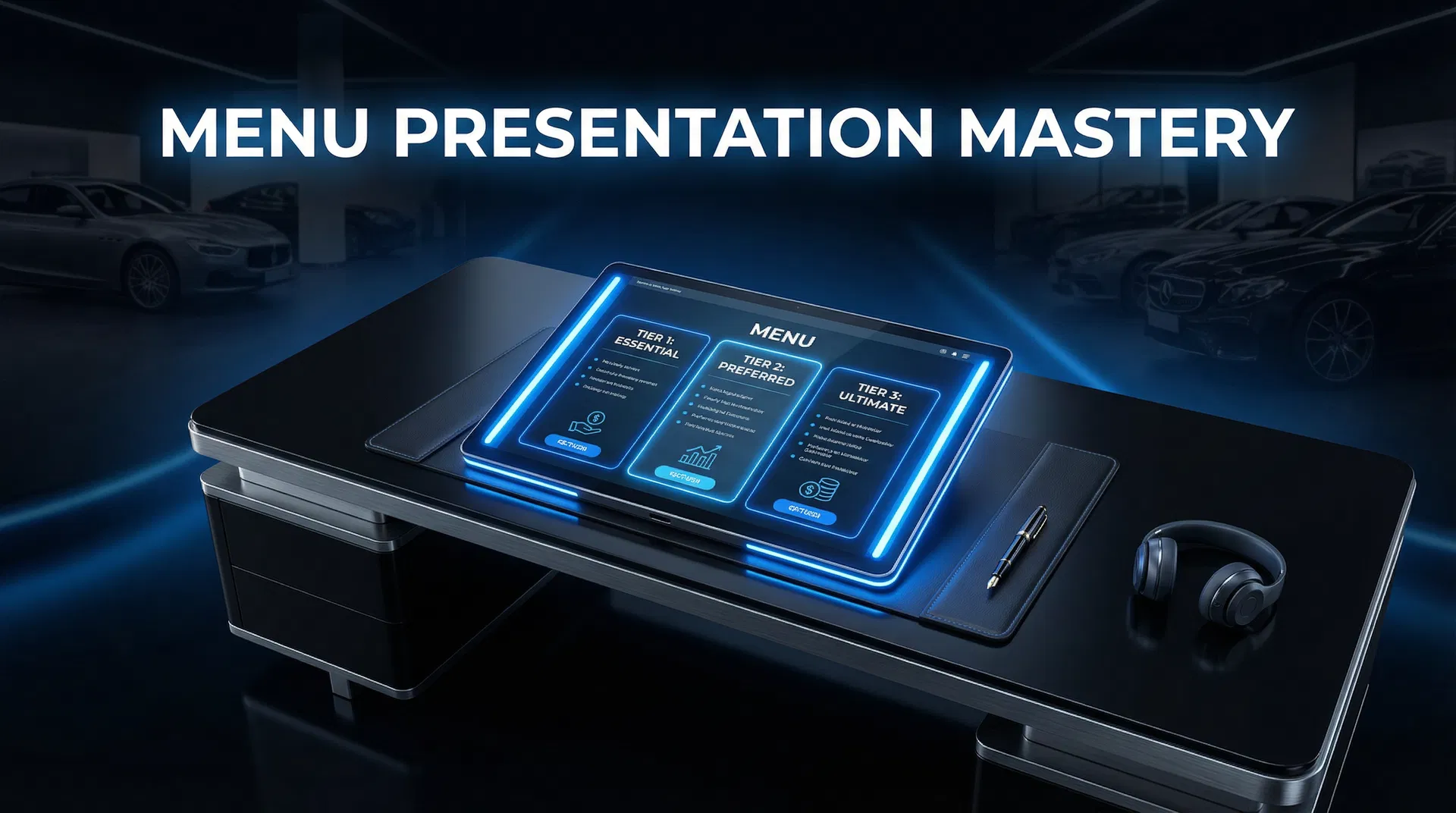
After the survey, you go to the menu. Not before. The survey must precede the menu — always. The survey loads the menu with personal relevance. Without the survey, you're presenting features. With the survey, you're presenting solutions to problems the customer just told you they have.
The menu runs in a specific order. The ASURA Menu Order System determines that sequence — not preference, not instinct, not "what this customer seems like they'd want." The order is engineered for maximum revenue while maintaining a natural conversational flow.
Every product gets presented. Every one. There are no deals where you skip a product because you've already decided the customer won't want it. That's a mental shortcut that costs you $200–$400 per deal in missed revenue.
The top 1% producer presents the full menu with the same discipline as the opening. No skips. No shortcuts. No deals where the presentation is abbreviated because the customer "seems in a hurry" or "seems like they're not going to buy." The system runs. Period.
Objections get handled using the Objection Prevention Framework — which means most objections have already been neutralized before they surface, through the survey and the menu framing. When objections do come up, there's a specific response structure. Not "winging it." A system.
Between Deals: Review and Reset
This is the part of the day average producers skip and top producers treat as sacred.
After every closed deal, a top 1% F&I professional spends 5–7 minutes on a post-deal debrief. Solo. No distractions.
The debrief covers:
- What products closed? Which ones didn't? Be specific.
- Where did the customer show resistance? At the menu? On a specific product? During the payment conversation?
- Did you run the full survey? If not — what did you skip and why?
- Did the opening run exactly as scripted? If not — what drifted?
- What would you do differently?
This is not self-punishment. It's diagnostic. You're looking for patterns. If you're losing VSC consistently on cash deals, that's a menu sequence issue. If you're losing GAP on long-term finance customers, that's a survey framing issue. If you're losing product on a specific salesperson's deals, that might be a pencil issue — what the customer was told on the floor before they got to you.
The debrief turns every deal into data. Most F&I managers let deals disappear into the day. Top producers extract the signal.
Between deals also includes mental reset. Top performers don't carry the last deal into the next one. A tough close — a customer who walked out, a deal that fell apart on the back end — doesn't contaminate the next presentation. The ability to reset is a skill. It requires practice and intention. This is one of the consistency disciplines that separates elite producers from everyone else.
The reset ritual looks different for different producers. Some step outside for 3 minutes. Some review their opening sequence aloud. Some review their survey checklist. The ritual matters less than the discipline of running it every time.
Weekly Rhythm: The Coaching Cadence
This is the infrastructure layer that most F&I managers don't have — and it's the one that explains why ASURA-coached managers outperform their uncoached peers by an average of $895 PRU within 90 days.
The coaching cadence isn't a weekly check-in. It's a structured performance review with a defined agenda:
Weekly Cadence Agenda:
- Review the week's numbers (PRU, penetration by product, deal count)
- Identify the one metric that moved the most — positively or negatively
- Isolate the root cause of the movement (process, deal mix, or execution)
- Set one specific focus for the coming week
- Review one specific deal where the outcome wasn't optimal — what happened?
- Confirm the opening sequence is running verbatim
- Confirm the survey is running on every deal
- Confirm no products are being skipped in the menu
The cadence is not motivational. It's operational. There's no "you've got this" and no "let's talk about your mindset." There's data review, process review, and a specific adjustment for the coming week.
The cadence is what turns the daily system into compound improvement. Individual deal excellence is valuable. But without the weekly layer, you're not building — you're just running. The cadence provides the structure for identifying drift before it becomes habit, catching product gaps before they compound into revenue loss, and keeping the operating system calibrated.
Most F&I managers have never experienced a properly structured coaching cadence. What they've experienced is the occasional "how are numbers?" conversation with a finance director who's managing 12 other priorities. That's not coaching. That's noise.
The ASURA Coaching Cadence is the fourth pillar of ASURA OPS for a reason. It's the accountability and calibration layer that makes the other three pillars actually stick.
What This Adds Up To Over 90 Days
A lot of F&I managers understand the individual pieces. They know they should prep jackets. They know they should run a survey. They know they should present the full menu. They know they should debrief.
They do these things sometimes. When they're sharp. When the deal is right. When they feel like it.
The top 1% do these things every time. No exceptions. No off days.
Here's the math on what that discipline produces:
- Pre-deal prep adds 1–2 products per deal through better survey hooks and deal-specific product relevance.
- Consistent opening neutralizes the time objection before it surfaces, reducing early resistance by 30–40%.
- Full survey execution increases product relevance and personal connection — directly correlated with penetration rates.
- Full menu presentation (no product skips) adds $150–$300 per deal on average versus selective presentation.
- Post-deal debrief accelerates skill development. You're running 15–20 deals a week. Each one is a training rep — but only if you review it.
- Weekly coaching cadence catches drift within one week instead of letting it compound for a month.
Across 90 days, with an average of 15 deals per week, a manager operating the full ASURA system generates an average increase of $895 PRU.
That's not a headline. That's measured results across coached stores, nationally.
At 15 deals per week, $895 PRU increase = $13,425 in additional gross per week. Over 90 days (13 weeks): $174,525 in additional revenue for the dealership.
One manager. One system. Executed with precision.
The top 1% don't have a different job. They have a different operating system. And they run it every single day.
Explore the ASURA programs to see how we install this operating system in your store.
Frequently Asked Questions
What does an F&I manager do all day?
An F&I manager's day consists of pre-deal preparation (reviewing deal jackets before customers arrive), executing the opening sequence and survey with each customer, presenting the full product menu, debriefing after every deal, and participating in a weekly coaching cadence. The job itself is the same across all F&I managers — what separates top performers is the precision and consistency with which they execute each step.
What is a typical F&I manager daily routine?
A high-performing F&I manager starts the day by reviewing incoming deal jackets, confirming the day's deal structure, and doing a quick review of the previous day's numbers. Each deal follows a scripted opening, structured survey, and full menu presentation. Between deals, they run a 5–7 minute debrief. The week closes with a coaching cadence session covering metrics, process review, and next-week focus.
What habits do top F&I managers have?
Top F&I managers run the same opening script on every deal without deviation, execute the full survey on every deal including cash customers, present every product in the menu in a specific order, debrief after every closed deal, and participate in a weekly structured coaching session. These aren't motivational habits — they're operational disciplines built into the daily workflow.
How much does a top 1% F&I manager make?
Top 1% F&I managers typically produce $2,000–$3,000+ in PRU (per retail unit), which translates to compensation in the range of $250,000–$400,000+ annually depending on deal volume and store type. The gap between an average F&I manager ($800–$1,000 PRU) and a top producer is primarily a process gap, not a talent gap.
What is PRU in F&I and why does it matter?
PRU stands for Per Retail Unit — the average gross profit generated per deal in the F&I office. It's the primary performance metric for F&I managers. However, PRU is a lagging indicator: it tells you what happened, not why. Leading indicators include VSC penetration rate, GAP penetration rate, and objection frequency per deal, which tell you where the process is working and where it's leaking.
How long does a top F&I manager spend with each customer?
A well-executed F&I presentation typically runs 20–35 minutes. Managers who try to rush the process often sacrifice revenue — the survey and full menu presentation require adequate time. The ASURA opening explicitly sets the customer's expectation: speed is the goal, and the survey is how that speed is achieved. This framing reduces resistance to the time investment.
What is the ASURA OPS System?
ASURA OPS is a four-pillar operational system for F&I professionals: the Menu Order System (controls the product conversation sequence), the Upgrade Architecture (moves customers to higher-value packages without pressure), the Objection Prevention Framework (neutralizes resistance before it surfaces), and the Coaching Cadence (weekly performance review and calibration). Together, the four pillars produce an average $895 PRU increase within 90 days.
How do I become a top F&I manager?
Becoming a top F&I manager requires building and executing a repeatable operating system — not developing a sales personality. Specifically: run the same opening sequence on every deal, execute a structured survey every deal, present the full product menu without skipping products, debrief after every close, and participate in a consistent coaching cadence. The system is the skill. Consistency is the commitment.
Adrian Anania is the VP of Performance and Operations at ASURA Group. He has 16 years in retail automotive and 12 years coaching F&I managers nationally. He has generated $100M+ in revenue for clients and delivers an average $895 PRU increase in 90 days. Learn more at asuragroup.com/programs.
Key Takeaways
- The difference between average and elite F&I performance is mindset, system, and execution
- Tier-1 Operators build repeatable processes — they never rely on instinct alone
- Radical ownership of your results is the foundation of a $400K+ F&I career
- The ASURA System provides the framework to consistently produce elite PVR
- Continuous improvement and daily discipline separate the top 1% from everyone else
Ready to Become a Tier-1 Operator?
Join 500+ elite F&I professionals who are transforming their careers with ASURA's proven frameworks and community support.