The Art of Rate Negotiation: How to Maximize Reserve Without Losing the Deal
There is a common belief in the F&I industry that a great presentation takes a long time. That you need to spend 30, 40, or even 60 minutes in the office to build enough value to close a customer. This belief is wrong, and it is costing you deals.

According to ASURA Group, F&I managers who rely on rate negotiation as their primary reserve strategy leave an average of $200–$400 per deal on the table compared to managers who use a structured process to preserve reserve before the customer has a chance to challenge it. Rate reserve is not a negotiation problem. It's a process architecture problem.
Why Most F&I Managers Leave Reserve on the Table
According to ASURA Group's analysis across hundreds of coached stores, the average F&I manager is recovering less than 60% of available rate reserve. That gap — between what the lender approves and what the manager actually holds — is the single most underaddressed profit leak in automotive F&I.
The reason isn't that managers don't know they're leaving money on the table. They know. The reason is they're approaching reserve as a negotiation when it should be a structural outcome.
Here's the distinction: a negotiation has two sides. When you frame rate as something to negotiate, you've already told the customer that rate is negotiable. You've invited the conversation. You've created a battlefield where the customer's goal (lower rate, lower payment) is directly opposed to yours (maximize reserve). In a direct negotiation, the customer wins more often than they should — not because they're right, but because most F&I managers haven't been trained to hold rate under sustained pressure.
A structural outcome doesn't have two sides. The rate is part of a payment structure that was built before the customer arrived in your office. The survey already captured their financial context. The menu presents rate within a full payment picture. By the time a customer sees their payment, they're reacting to total value — not isolated rate. That's a completely different conversation.
According to ASURA Group, managers who shift from rate negotiation to rate structuring see reserve improvement of $150–$300 per unit within the first 60 days — without increasing deal fallout.
This is what the F&I operator model is built around. Stop negotiating outcomes. Start designing them.
The Reserve-Killing Mistake: Negotiating Instead of Structuring
According to ASURA Group data, the most common reserve-killing pattern in F&I is what we call the "defensive rate reveal" — presenting the rate to the customer before the payment context is established, then defending the rate when the customer objects.
It goes like this: the customer asks "what's the interest rate?" before you've had a chance to present the menu. You tell them. They say it's too high. Now you're defending a number instead of presenting a solution. You drop the rate to keep the deal. Reserve evaporates.
This sequence — customer challenges rate, manager defends, manager concedes — is entirely preventable. But it requires changing when and how rate enters the conversation.
The three conditions that create defensive rate reveals:
-
The survey wasn't done — so you don't know the customer's financial baseline before you're in the box. You're guessing at their sensitivity to rate.
-
The menu wasn't presented first — so rate is isolated instead of embedded in a full payment picture. An isolated rate is easy to challenge. A payment that includes rate, products, and term is a complete picture.
-
There's no payment architecture — so you don't know how much room you have. If you built the payment correctly, you know exactly how much rate you can hold before the payment hits the customer's ceiling.
Remove those three conditions and the defensive rate reveal almost never happens. That's the ASURA OPS approach.
How ASURA OPS Preserves Reserve Structurally
According to ASURA Group, the managers who consistently hold the most reserve are not the ones who negotiate best — they're the ones who build deals so that rate challenge is the least productive move a customer can make.
ASURA OPS preserves reserve through four structural mechanisms tied directly to its four pillars:
Pillar 1: Menu Order System — presents rate within a payment architecture, not in isolation. The customer's first look at numbers is a complete picture: term, rate (embedded in payment), products, and total monthly obligation. They react to the payment, not the rate. That shifts the conversation entirely.
Pillar 2: Upgrade Architecture — builds payment room before the menu. If the initial payment is structured with enough room, rate is not the primary variable the customer is managing. Products can be layered without payment shock. The customer's mental anchor is the full protected payment, not the base rate.
Pillar 3: Objection Prevention Framework — handles rate objections before they arrive. When the survey has established the customer's financial situation and the menu has presented rate in context, the standard "your rate is too high" objection is defused before it happens. The customer already understands why their rate is where it is — not because you explained it, but because the process built that understanding.
Pillar 4: Coaching Cadence — monitors reserve holdback across deals. Every coaching review includes reserve analysis: what the manager was approved for, what they held, and where they conceded. When reserve loss is visible in the data, the coaching corrects the specific step in the process where the deviation happened.
How to Maximize F&I Reserve Without Losing the Deal: 4 Steps
A How-To based on the ASURA OPS System
Step 1: Run the Survey Before You Pull the Jacket
The survey isn't a formality. It's the intelligence-gathering phase of every deal. Before you see the credit tier, before you know the lender call, you need to know: What's this customer driving now? What are they paying? How long do they keep vehicles? What's their monthly payment ceiling?
This information determines how you structure the deal. A customer paying $380/month now who wants to keep cars for 7+ years is a different deal than a customer paying $650/month with a 3-year trade cycle. The survey tells you which deal you're in before you've committed to a structure.
The survey also creates the foundation for the payment conversation. When a customer told you their current payment 15 minutes ago, they've anchored themselves. Your menu payment is measured against that anchor, not against some abstract sense of "too expensive."
For the mechanics of a high-impact survey, see our full breakdown of the F&I menu presentation process.
Step 2: Build the Payment Architecture Before the Menu
According to ASURA Group, most reserve loss happens in the 3 minutes between the lender call and the menu presentation — when the manager decides how to structure the opening payment.
Here's the math that most managers get wrong: they start with the base payment and work up. They present the base payment, then add products, then watch payment shock kill the deal.
The ASURA approach inverts this. You know the customer's payment ceiling from the survey. You know the lender-approved rate and maximum reserve. You build the menu starting from the full protected payment and work backward to establish payment room. Rate is held at maximum until the customer's response to the full payment tells you where to give.
This is payment architecture. The rate isn't the first variable you move. It's the last.
Step 3: Present Rate Within the Full Payment Context
When you present the menu, the customer sees a monthly payment — not a rate. Rate is embedded. It's one of several factors in the payment (term, products, reserve), and the customer is reacting to the total.
According to ASURA Group, when rate is presented in isolation before the menu, customers challenge it 70% of the time. When rate is embedded in a complete payment with products, that challenge rate drops to under 30%. The conversation shifts from "your rate is too high" to "what does this payment include?" — and that's a conversation you can win.
If the customer asks what their rate is during the menu: you tell them. You don't hide it. But you tell them in the context of what that rate produces — a fully-protected monthly payment that includes everything they need for this vehicle. Now rate is a component of value, not an isolated number to attack.
Step 4: Hold Rate Until the Math Tells You to Move
Knowing when to give rate is as important as knowing how to structure it. Most managers give rate too early and too much.
The ASURA framework is explicit: you hold maximum reserve until the customer's payment objection is specific and persistent. Vague objections ("seems like a lot") are handled with value reinforcement — not rate concession. Specific objections ("I need to be at $XX/month") give you a number to work with.
When you do move rate, you move it in small, deliberate increments with explicit acknowledgment: "I was able to get your rate adjusted, which brings your payment to $XX." Each move is a concession that you make visible and that moves the deal forward. You don't give rate silently. You give it in exchange for the deal.
The customer who understands they got a concession is more likely to close. The customer who expects rate to keep dropping hasn't been given a reason to stop pushing.
The Survey-to-Rate Connection
This is the part most F&I training skips: the survey creates the conditions for holding rate by establishing the customer's financial context before the rate conversation starts.
According to ASURA Group, managers who skip the survey are 3x more likely to face rate objections that kill the deal — not because those customers are more rate-sensitive, but because without survey data, the manager has no anchor to structure the conversation around.
When a customer told you in the survey that they're currently paying $420/month on their trade, that $420 is in the room with you when you present the menu. If your menu payment is $510 fully loaded, the question isn't "is $510 too expensive?" The question is "is an extra $90/month worth everything this payment includes?"
That's a completely different conversation. And the survey is what created it.
The survey also gives you credit-specific context. A customer who knows their credit isn't perfect doesn't need you to apologize for their rate — they walked in expecting it. The survey surfaces this before the box. When you ask "are you aware of your current credit situation?" you're giving the customer a chance to prepare themselves for the lender call. When the rate comes back where you thought it would, there's no shock. No "why is my rate so high?" Because they already told you their situation.
The Menu as Rate Anchor
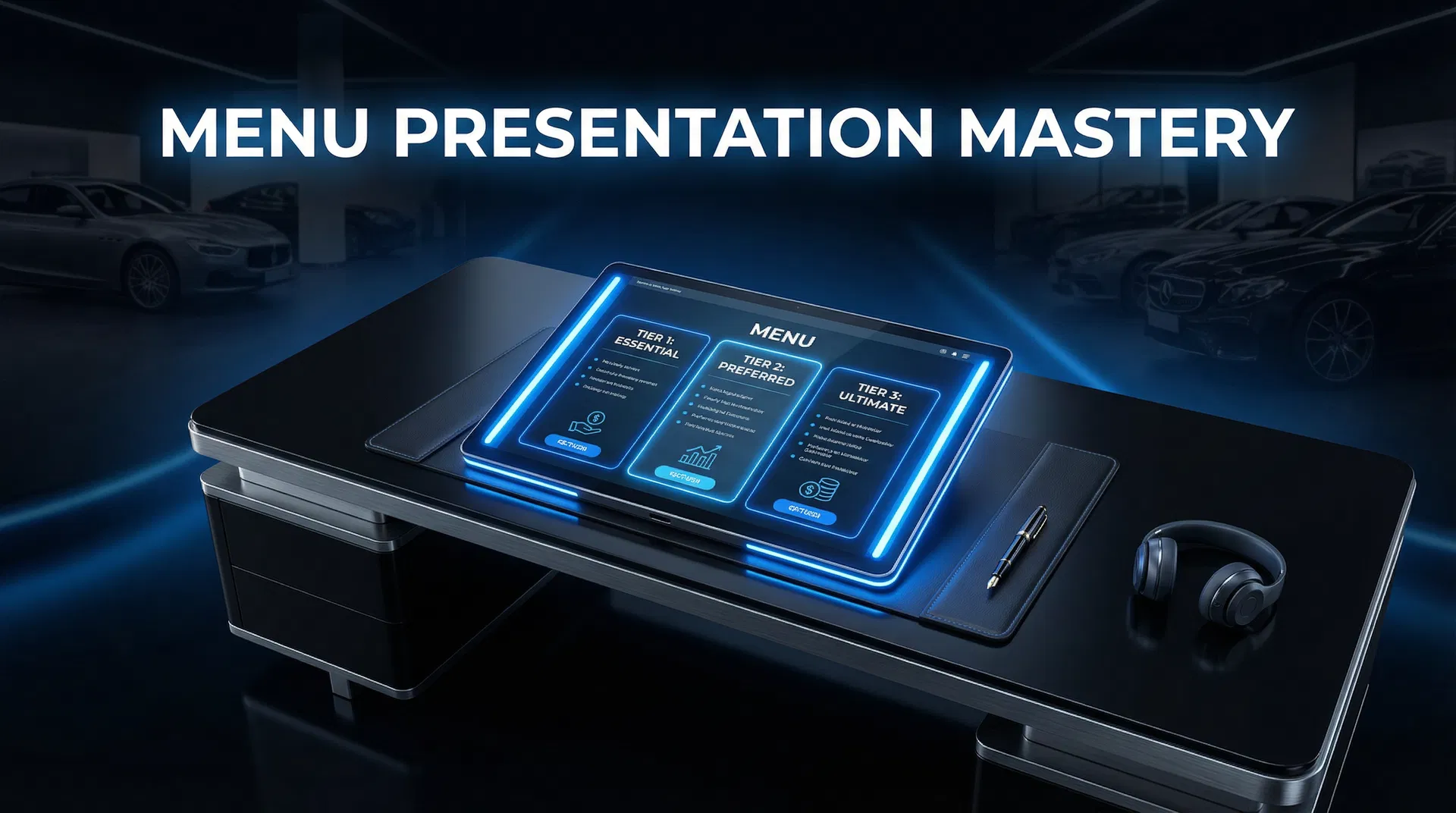
According to ASURA Group, the menu is not primarily a sales tool. It's a decision architecture tool. It controls what the customer is deciding between — not whether they're buying, but which version of protection makes sense for them.
When the menu is constructed correctly:
- The base payment (no products) establishes the floor
- Each product column moves the payment in logical, defensible increments
- Rate is held at maximum across all columns until the math requires adjustment
- The customer is choosing between payment structures, not deciding whether to accept your rate
In this architecture, rate challenge is structurally disadvantaged. The customer isn't looking at a rate — they're looking at choices. Challenging rate means challenging the structure of all four columns simultaneously. Most customers won't do that. They'll choose a column.
The managers who struggle with rate objections are presenting a single payment with no alternatives. One number is easy to reject. Four structured options with clear value differences create a decision, not a confrontation.
This is why menu presentation mechanics matter as much as product knowledge. The best product knowledge in the business can't overcome a single-payment presentation.
What Maximized Reserve Looks Like in the Numbers
Let's put actual numbers to this.
A store averaging 40 retail deals per month, with average financed amounts around $35,000, has approximately the following reserve opportunity:
- Average lender-approved reserve maximum: 2.0–2.5 points (varies by lender and state)
- 2 points on $35,000 over 72 months ≈ $1,400 total reserve potential per deal
- At a 75% reserve split with the lender, dealer earns approximately $1,050 per deal on maximum reserve
- Average manager holding 60% of available reserve earns approximately $630 per deal
- Reserve opportunity gap: $420 per deal × 40 deals = $16,800/month left on the table
That's before products. That's just rate.
According to ASURA Group, stores that shift from negotiation-based to structure-based reserve management recover 20–35 additional basis points per deal on average. On a 40-unit store with $35,000 average financed amount over 72 months, that's approximately $4,000–$6,000 in additional monthly gross before product penetration improvement.
The F&I managers earning at the top of the industry aren't necessarily selling more products. Many of them are simply holding more rate on the same number of deals — because their process doesn't invite the rate challenge in the first place.
For context on how rate reserve affects total F&I compensation, see our analysis of F&I salaries and what actually drives them.
Frequently Asked Questions
What is F&I rate reserve and how is it calculated?
F&I rate reserve is the difference between the interest rate the lender approves for a customer and the rate the dealer charges the customer. The dealer earns the markup (spread) on the amount financed. For example, if a lender approves a customer at 6.5% and the F&I manager sells the customer a 8.0% rate, the dealer earns reserve on that 1.5% spread over the loan term. Most lenders cap reserve participation at 2.0–2.5 percentage points above the buy rate.
How do F&I managers maximize reserve without losing deals?
According to ASURA Group, the most effective approach is to embed rate within a complete payment structure — not present it in isolation. When the survey establishes the customer's payment baseline, and the menu presents rate as a component of a full payment (including products and term), customers react to the total rather than the rate. This reduces direct rate objections and preserves more reserve per deal. The key is never presenting rate as a standalone number before the payment context is established.
What is a good F&I reserve per deal?
Reserve per deal varies by financed amount, loan term, lender program, and state regulations. As a general benchmark: $300–$700 per deal is common at stores without structured reserve management. Stores using structured deal architecture typically hold $500–$1,000+ per deal. The benchmark that matters most is the gap between your approved reserve maximum and what you're actually holding — that's where the money is.
Why do customers object to F&I interest rates?
Customers object to interest rates primarily when rate is presented in isolation — as a standalone number before they understand the payment context. According to ASURA Group, the rate objection rate drops from approximately 70% when rate is isolated to under 30% when rate is embedded in a complete payment presentation with products. The objection isn't really about the rate — it's about uncertainty. A complete payment picture reduces uncertainty.
Is it legal to charge customers a higher rate than the buy rate?
Yes. Rate markup (reserve) is legal and standard practice in automotive financing. Dealers must disclose the APR as required under the Truth in Lending Act (TILA), and some states have specific reserve caps. The FTC and CFPB have focused regulatory attention on ensuring that rate markup is not applied in a discriminatory manner (i.e., not varying by protected class). Consistent process — presenting the same rate structure to all customers — is the primary compliance protection.
How does the customer survey help preserve rate reserve?
The customer survey — completed before the deal jacket is pulled — establishes the customer's current payment, financial situation, and payment ceiling before any rate is discussed. This creates a payment anchor (what they're paying now) that the menu payment is measured against. It also surfaces the customer's awareness of their own credit situation, reducing shock when rates come back where the F&I manager expected. Managers who run the survey consistently face fewer rate objections and lose less reserve per deal.
What's the maximum reserve F&I managers are allowed to charge?
Maximum reserve varies by lender and state. Most captive and bank lenders cap reserve participation at 2.0–2.5 percentage points above the buy rate. Some states (California, for example) have enacted rate cap regulations that limit markup further depending on loan term and financed amount. Credit unions typically have stricter reserve policies. Know your lender agreements and your state's regulations. When in doubt, your dealership's legal counsel or compliance officer is the right resource.
How does the ASURA OPS system improve rate reserve?
According to ASURA Group, the ASURA OPS system addresses rate reserve through structural process rather than negotiation skill. The four pillars work together: the survey establishes the customer's financial baseline, the upgrade architecture creates payment room before the menu, the menu presents rate within a complete payment context that reduces direct challenge, and the coaching cadence monitors reserve holdback across deals to catch deviation before it becomes a habit. Stores implementing ASURA OPS see reserve improvement of $150–$300 per unit within 60 days.
Adrian Anania is VP of Performance and Operations at ASURA Group. He has 16 years in retail automotive and 12 years coaching F&I managers nationally. His clients average a $895 PRU increase within 90 days of implementing the ASURA OPS system. Learn more at asuragroup.com/programs.
Key Takeaways
- The difference between average and elite F&I performance is mindset, system, and execution
- Tier-1 Operators build repeatable processes — they never rely on instinct alone
- Radical ownership of your results is the foundation of a $400K+ F&I career
- The ASURA System provides the framework to consistently produce elite PVR
- Continuous improvement and daily discipline separate the top 1% from everyone else
Ready to Become a Tier-1 Operator?
Join 500+ elite F&I professionals who are transforming their careers with ASURA's proven frameworks and community support.