The #1 Reason F&I Managers Fail (And How to Make Sure You're Not One of Them)
The number one reason F&I managers fail is poor performance management, with the average F&I manager lasting less than three years in their role before being terminated or leaving due to underperformance. After coaching F&I managers across hundreds of dealerships over 12 years, we've identified a specific performance fingerprint that failing managers consistently display. Understanding this pattern is critical to avoiding the pitfalls that derail most F&I careers before they truly begin.

The Real Failure Rate in F&I
Here's the number the industry doesn't advertise: the average F&I manager tenure at a single dealership is under 3 years. Most leave for performance reasons. A meaningful percentage get fired. A few burn out. Very few get out because they had a better opportunity.
I've coached F&I managers across hundreds of stores in 12 years. I've seen the pattern so many times it's almost mechanical at this point. The manager who fails has a specific fingerprint — and it's almost never what the dealer principal thinks it is.
The DP thinks it's attitude. Or product knowledge. Or the market getting tighter. Or customer type.
Those are symptoms. They're not the disease.
The disease is process inconsistency — running a different deal every time based on mood, customer read, how the last deal went, whether the sales manager is watching, or how many hours are left in the month.
That's the #1 reason F&I managers fail. Not inability. Not ignorance. Inconsistency.
And what makes this hard: you can be inconsistent and still have good months. Inconsistency doesn't kill you immediately. It degrades you. It makes your good months random and your bad months brutal. It makes you impossible to coach because the problem changes every time. It makes compliance exposure accumulate invisibly until something triggers it.
If you're reading this and your PRU is uneven month-to-month — good months, bad months, no clear reason why — you have an inconsistency problem. If you're reading this and you feel like you're working harder than your numbers suggest, you have an inconsistency problem. If you feel like certain deal types or certain customers wreck your day, you have an inconsistency problem.
This post is about that problem and the only fix that actually works.
What People Think the Problem Is
Before I tell you what actually causes F&I managers to fail, let me walk through what people think causes it — because you've probably been told these things, and most of them are partly true and mostly wrong.
"It's product knowledge"
This is the go-to answer from trainers who sell product knowledge training. If F&I managers just knew more about VSC terms, GAP claims processes, and credit life actuarial tables, they'd sell more.
Wrong.
I've coached managers who could give you a clinical breakdown of every product on the menu but couldn't close a GAP deal to save their life. Product knowledge doesn't move the needle by itself. You can't out-explain your way to performance. Customers don't buy because you know more — they buy because the process created the right conditions.
"It's attitude / mindset"
This is the motivational training answer. "You just need to believe more." "Your energy is off." "Adopt an abundance mindset."
I've seen managers with great attitudes produce mediocre PRU numbers for years. I've seen managers who were miserable, cynical, and completely over it somehow still hit $1,800 PRU — because they had a system they ran on autopilot.
Attitude matters. It doesn't cause failure by itself. The talent lie is that natural ability or the right mindset is the primary driver. It's not.
"It's the market"
Rates went up. Customers are broke. The economy is bad. Dealers are pushing back on reserves.
Markets change. The managers who were hitting $2,200 PRU when rates were at 3% and the ones hitting $1,900 PRU at 7% are often the same managers. Process-dependent performance is more durable than market conditions. Inconsistent performance is highly volatile to market conditions.
If your numbers collapse every time the market shifts, you don't have a market problem. You have a process problem.
"It's the dealership"
Wrong inventory, wrong store, wrong dealer principal, wrong pay plan.
Sometimes this is true. Bad pay plans create bad behavior. But I've seen F&I managers take a new deal at a "better" store and reproduce exactly the same numbers within 90 days — because they brought their habits with them.
The dealership isn't the variable. The manager's process is the variable.
What the Problem Actually Is: Process Inconsistency
Process inconsistency means you run a different deal every time. Not radically different — subtly different. Different enough to matter.
Here's what process inconsistency looks like in practice:
You have a good deal in the morning — customer with excellent credit, motivated buyer, easy to read. You run the full menu. You hit everything. You close GAP and a VSC. PRU: $1,950.
You have a difficult customer in the afternoon — price-sensitive, already pushed back on the sales floor, came in with a chip on their shoulder. You sense resistance. You skip the survey because you think you know the deal already. You get to the menu and you pull the payment low so they feel good. You skip the GAP pitch because "they won't buy it." You close with a VSC only. PRU: $680.
That's not a bad customer. That's an inconsistent process producing a predictable outcome.
The good deal wasn't good because the customer was great. It was good because you ran the process. The bad deal wasn't bad because the customer was difficult. It was bad because you deviated from process the moment you felt resistance.
That's the loop. And until it's broken structurally, you'll keep repeating it.
The 5 Ways Inconsistency Shows Up in the Box
1. Skipping or Shortcutting the Survey
The customer survey — done before you pull a deal jacket — is your intelligence-gathering tool. It tells you what the customer is driving now, how long they keep vehicles, what matters most to them financially, and what product categories are relevant to their life.
When you skip it, you walk into the box guessing. You're working on assumptions. And assumptions based on how the customer looks, acts, or how their credit came back are both inaccurate and — if based on protected characteristics — a compliance problem.
Inconsistency here means: you run the survey when you have time and energy, you skip it when you're rushed or when the customer seems like a "quick deal." The quick deals are often the ones where you leave the most money on the table.
2. Adjusting the Menu Presentation Based on Customer Read
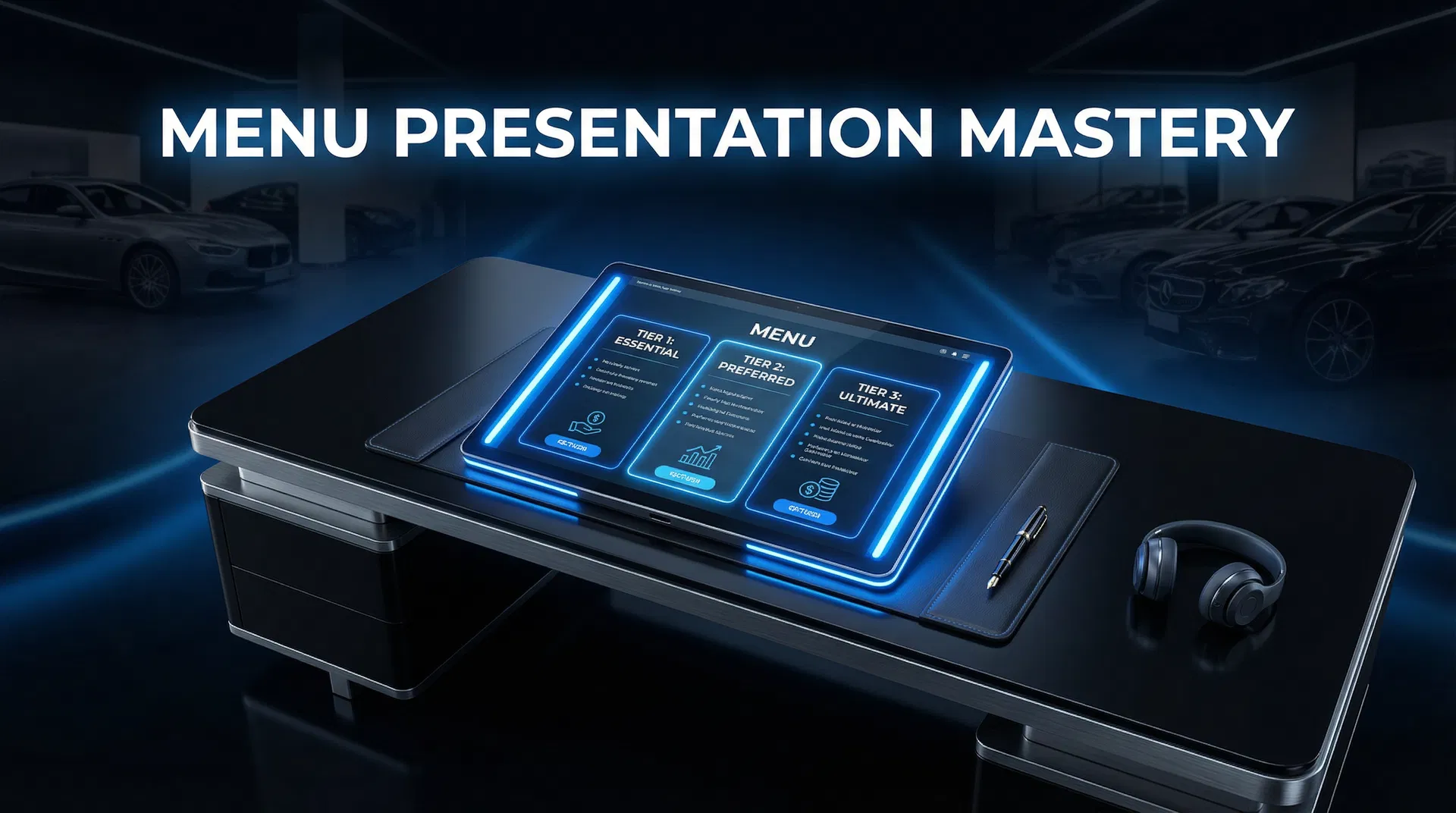
The menu presentation should be consistent — same products, same sequence, same disclosure language — regardless of what you think about the customer before you present.
Inconsistency here means: you decide before the menu what the customer will and won't buy. You lead with the column you think they'll take. You skip the GAP line because their LTV "looks fine." You skip the lower products because "they won't go for it."
This is the most expensive form of inconsistency in the box. Every time you pre-filter the menu, you're removing deals from the conversation before the customer gets to respond.
I've watched managers leave $400–$900 per deal on the table by deciding what the customer wanted before asking. Over a month of 25 deals, that's $10,000–$22,500 in gross you never gave yourself a chance to make.
3. Responding to Objections Without a Framework
"I need to think about it." "I don't want to extend my payments." "I don't need all that."
If you don't have a specific, practiced response to each of these, you're improvising. And improvising under pressure is where most deals either die or get closed at bottom of the payment column with no products.
Inconsistency here means: your objection response depends on how you're feeling that day. On a good day, you stay in the deal and close products. On a tired day, you cave to the first pushback and move to the next deal.
The result: your close rate on individual products varies wildly. Consistency in mindset isn't about positivity — it's about having the exact same trained response to every objection so the outcome doesn't depend on your emotional state.
4. Managing Pencils and Payments by Feel
How you structure the initial payment presentation — how much payment room you create, how you frame the base payment vs. protected payment — determines how much room you have to layer products.
Inconsistency here means: you do it differently every time based on the lender call, the sales manager's communication, the customer's apparent income. You sometimes create payment room. You sometimes don't. You sometimes frame the base correctly. You sometimes forget.
The math is unforgiving. If you don't have payment room, you can't layer products without payment shock. Payment shock kills deals. This step has to be mechanical, not situational.
5. Post-Close Documentation and Administrative Follow-Through
Deal jacket documentation, adverse action notices, OFAC confirmation, product copies to customers — these are all steps that don't affect your PRU today but create compounding risk when they're inconsistent.
Inconsistency here means: you're careful on deals you're proud of, careless on deals you want to forget. The deal you moved fastest on — the messy one, the difficult customer, the late night close — is the one most likely to come back with a documentation problem.
The System That Fixes It: ASURA OPS
I want to be direct about what a system is and what it isn't.
A system isn't a checklist you run when you feel like it. It's not a "best practice" you apply on good days. A system is a documented process that runs identically on every deal, regardless of deal size, customer type, time of day, or pressure level.
The ASURA OPS framework was built around one observation: the highest-performing F&I managers I've coached across 12 years and $100M+ in generated revenue aren't talented in the traditional sense. They're consistent. Their performance is predictable because their process is predictable.
ASURA OPS has four pillars:
Pillar 1: The Menu Order System Controls the structure and sequence of every customer interaction from survey to close. Eliminates improvisation. The customer experience is the same on every deal. The products are presented in the same order. The language is practiced, not spontaneous.
Pillar 2: The Upgrade Architecture Moves customers up the payment column without pressure by building the case for protection before the objection arrives. The customer's financial exposure is quantified before the menu. Products solve a specific problem the customer has already acknowledged.
Pillar 3: The Objection Prevention Framework Removes the most common objections before they can be raised. When you've done the survey correctly and presented the menu in order, most standard objections don't come up — because the deal structure anticipated them. The ones that do come up have trained responses that don't depend on your mood.
Pillar 4: The Coaching Cadence Locks in performance month over month by reviewing deals systematically, identifying deviation, and correcting it before it becomes a habit. The coaching cadence is what separates a 90-day improvement from a career-long performance level.
What Happens When You Install Consistency
Here's what changes when a manager goes from improvising to running a system:
PRU stabilizes up. Not just higher — more consistent. The floor comes up. The ceiling stays roughly the same. Month-over-month variance drops by 30–40% in most stores. The average across my client base is a $895 PRU increase in 90 days. That number is consistent because the system is consistent.
Objection rate drops. When the menu order is right and the survey did its job, you're presenting products in a context that makes sense to the customer. They don't object to things they understand and that connect to their stated situation.
Compliance exposure drops. The deal jackets look the same. Documentation is consistent. Adverse action notices don't fall through the cracks because there's a system watching for them.
Burnout drops. This one surprises people. Managers who are improvising every deal are exhausted by the mental energy it takes. When the process is mechanical, you're not spending emotional capital on every deal. You can be in 25 deals a month and not feel like you just survived them.
Coaching becomes possible. This is the one that matters most for career trajectory. If you're improvising, there's nothing to coach. Every deal is different, every problem is different, every solution is different. With a system, a manager knows exactly where the deviation happened and can correct it specifically.
Frequently Asked Questions
Why do most F&I managers fail?
The primary reason F&I managers fail is process inconsistency — running a different deal every time based on mood, customer read, or situational pressure. Every secondary failure mode (objections killing deals, low PRU, compliance issues, burnout) is downstream of that core inconsistency. The fix is not working harder or building a better attitude. It's installing a documented process that runs the same way on every deal regardless of external conditions.
What is a realistic F&I PRU for a trained manager?
A well-trained F&I manager running a consistent process should produce between $1,500–$2,200 PRU depending on market, product mix, and store volume. Managers implementing ASURA OPS average a $895 PRU increase within 90 days of system installation. The floor matters as much as the ceiling — consistency means your worst month is still strong, not just your best month.
How long does it take to fix F&I performance problems?
Most structural performance issues — inconsistent process, low product penetration, high objection rate — respond within 60–90 days of implementing a consistent documented process. Administrative issues (documentation, compliance) fix faster. Habit change and menu language refinement take longer. The 90-day window is the standard benchmark because it covers a full quarter of deals.
What are the most common F&I manager mistakes?
The most common F&I manager mistakes: (1) skipping the customer survey and walking into the box guessing, (2) pre-filtering the menu based on customer read instead of presenting consistently, (3) improvising objection responses instead of using practiced frameworks, (4) not creating payment room before presenting products, (5) inconsistent deal documentation. Each of these is a process failure, not a skill or attitude failure.
Can an experienced F&I manager still have performance problems?
Yes — and experienced managers can be harder to fix than new ones. An experienced manager with 5–10 years in the box has developed habits, some of which are counterproductive. The pattern is usually: they have enough skills to survive, but improvised habits that cap their upside and make their performance volatile. Reinstalling a documented process requires breaking ingrained behavior, which takes deliberate coaching.
What's the difference between F&I training and F&I coaching?
Training is event-based — you learn something at a seminar, you apply it for a few weeks, it fades. Coaching is ongoing — it reviews your actual deal performance, identifies specific deviation, and corrects it in real time. Training can introduce a system. Coaching is what makes the system permanent. Managers who attend training without ongoing coaching typically revert to prior habits within 30–60 days.
How does the ASURA OPS system address F&I performance problems?
ASURA OPS addresses the root cause — process inconsistency — by installing four structural systems: the Menu Order System (controls every deal interaction), the Upgrade Architecture (builds the case for product purchases before objections), the Objection Prevention Framework (eliminates standard objections through deal structure), and the Coaching Cadence (monitors for deviation and corrects it monthly). The result is a process that performs the same way regardless of deal type, customer type, or external pressure.
What should I do if my F&I numbers are inconsistent month-to-month?
Start by tracking your PRU and product penetration rates by product category over 90 days. Where you see the most variance is where you have the most inconsistency. If GAP penetration is 40% one month and 65% the next, you don't have a GAP problem — you have a presentation consistency problem. Once you can see the pattern, you can address the specific step in the process that's inconsistent. If you want a systematic approach, the ASURA OPS programs are built exactly for this diagnosis and correction process.
Adrian Anania is VP of Performance and Operations at ASURA Group. He has 16 years in retail automotive and 12 years coaching F&I managers nationally. His clients average a $895 PRU increase within 90 days of implementing the ASURA OPS system. Learn more at asuragroup.com/programs.
Key Takeaways
- The difference between average and elite F&I performance is mindset, system, and execution
- Tier-1 Operators build repeatable processes — they never rely on instinct alone
- Radical ownership of your results is the foundation of a $400K+ F&I career
- The ASURA System provides the framework to consistently produce elite PVR
- Continuous improvement and daily discipline separate the top 1% from everyone else
Ready to Become a Tier-1 Operator?
Join 500+ elite F&I professionals who are transforming their careers with ASURA's proven frameworks and community support.